Pennington
Mariners' Museum, Uncurated Search Results
Type: Schooner Barge
Year: 1917
Builder: Coastwise Shipbuilding Co.
Location: Baltimore

These records are found in the online catalog of The Mariners’ Museum and Park in Newport News, Virginia. Uncurated search results are presented to give researchers and interested readers an idea of whether the museum’s archives contain information about this vessel and whether it may be worthwhile to visit the museum’s catalog search page for further investigation. Uncurated results may be inaccurate or incomplete.
Search mode: Exact Name. Search phrase(s): "Pennington". Results returned: 18. Results displayed in this table: 18.
Use these buttons to send uncurated search results to your own app or text document for further research. First, check the box for any row, or click "Select All" then uncheck any rows. Then click "Show Selections". You can then copy your selections from the text box and past them into your app.
| Fetch? | Row ID | Media | Date | Vessel | Place | Related Places | Inscription/Marks | Subject | Notes | Archive Number |
|---|---|---|---|---|---|---|---|---|---|---|
| 1 | 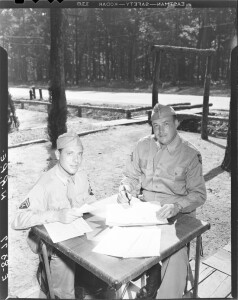 | 6/24/1944 | E8377 - T/5 Edward Clanson, 4301 Spouse Street, Philadelphia, Pa., and Pfc. Eugene E. Pennington, 1218 South Boots St. Marion, Ind., photographed at Camp Patrick Henry were both men are with the camp band. 6-24-44 Official Photograph, U. S. Army Signal Corps, HRPE, Newport News, Va. | Portraits.; Musicians–Virginia–Newport News. | Two men are seated at a folding card table outdoors. Both are holding sheet music, and one is noting his. | P0003/01-#E-8377 | ||||
| 2 | No image URL. | Harlem (New York, N.Y.)–History | Real property–New York (State)–New York | New Harlem past and present : __the story of an amazing civic wrong, now at last to be righted __by Carl Horton Pierce ; with a review of the principles of law involved in the recovery of the Harlem lands, by William Pennington Toler and Harmon De Pau Nutting | LB14040 | |||||
| 3 | 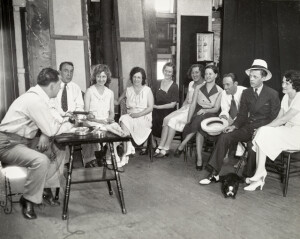 | 1932 | James Adams Floating Theatre. | photo by Charles Borges. | Left to right: Jack Pfeiffer, an unidentified actor and actress, Beulah Adams Hunter, Gladys Pennington Pfeiffer, Marion Hayworth, an unidentified actress, and Seabee Hayworth. The two on the far right are newlyweds, Dick Mason and Pearl Austin Mason. Boston Terrier is lying on the floor at the feet of Dick Mason. | P0001.010/01-#PJ105 | ||||
| 4 | No image URL. | Works issued by the Hakluyt Society, 0072-9396 ; 2d ser., no. 185-186. | Voyages and travels–Early works to 1800.; Travel in literature. | The Purchas handbook : __studies of the life, times and writings of Samuel Purchas 1577-1626, with bibliographies of his books and of works about him __edited by L.E. Pennington | LB35754 | |||||
| 5 | 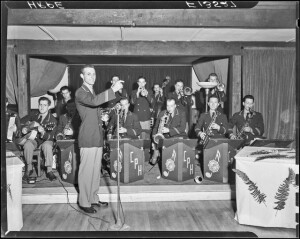 | 3/31/1945 | United States. Army–Bands.; United States. Army. Camp Patrick Henry (Va.). Officers' Club. | The dance band was organized in April, 1944, and all members were professional musicians before entering the service. Their uniforms are special issued maroon jacket with gray slacks and shirt with black tie. They all are either assigned or attached to the 469th ASF Band and play in the dance band in addition to their other duties. For names of members in the band see caption sheet. | Shows the band at their band stand with instruments raised. Their band leader is standing before a microphone. The 8x10 print reads: S/Sgt. Jack Edmondson, 42063354, Greensboro, North Carolina, is shown leading his Dance Band as they play for the Party given in the Officers' Club by the Supply and Facilities Division. The Band members are, front row, left to right: Pfc. Gus Harris, 3305444, Baltimore, Maryland, (guitar); Pfc. Paul Santa, 33686906, Pittsburgh, Pennsylvania, (tenor sax); T/4 Edward Clauson, 33805360, Philadelphia, Pennsylvania, (alto sax); T/5 Eugene Pennington, 35898843, Marion, Indiana, (baritone sax); Pfc. William Glick, 12202540, Newark, New Jersey, (alto sax); and Cpl. Jack Kranz, 32712156, Ridgewood, New York, (tenor sax). Second row, left to right: Pfc. Joseph Gillotte, 31407176, Danbury, Connecticut, (drums); Pfc. John Bishop, 35921584, Warren, Ohio, (trumpet); Pfc. Jack McKindley, 36860652, Kalamazoo, Michigan, (trumpet); T/4 William Robertson, 12132067, Hallock, Minnesota, (trombone), and Pfc. Robert Pinson, 34818184, Anniston, Alabama, (trombone). In the rear is Pfc. Al Moore, 338265598, Reading, Pennsylvania, (bass violin). Not shown is Pfc. Joseph Rein, 42080305, Bordentown, New Jersey, (accordion), and T/5 Fred Riddles, 35918856, Bedford, Ohio,) piano). | P0003/01-#F-13527 | ||||
| 6 | 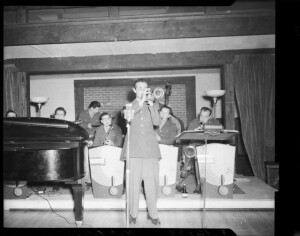 | 1/30/1945 | United States. Army. Camp Patrick Henry (Va.). Officers' Club. | United States–Armed Forces–Bands. | Photograph of Dance Band, 469th ASF Band, at Officers Club, Camp Patrick Henry, Va. Event: Buffet Supper and dance for HRPE Troop Movement Division and CPH Operations Division. Left to right: Pfc. Joe Rein, 42080305, Bordentown, N.J. (accordion); Pfc. Gus Harris, 33005444, Baltimore, Md. (guitar); Pfc. Joe Gillotte, 31407161, Danbury, Conn. (drums); Pfc. Paul Santa, 33686906, Pittsburgh, Pa. (saxophone); Leader - S/Sgt. Jack Edmonson, 42063354, Greensboro, N.C. (trumpet); Pfc. William Glick, 12202540, Newark, N.J. (saxophone); and T/5 Eugene Pennington, 35898843, Marion, Indiana, (saxophone). Photo taken at CPH for publicity purposes. | Music–Performance–Virginia–Newport News.; Musicians–Virginia–Newport News. | A trumpet player stands in front of his band, they are all in the act of playing music. The saxophonist Eugene E. Patterson might share credit on this piece of sheet music, http://www.loc.gov/item/2013570860/. | P0003/01-#F-12194 | ||
| 7 | No image URL. | Manganese. | Mining of manganese in sea. Photos of deep sea ventures mining projects and research vessels. Techniques of manganese mining. | LB73126 | ||||||
| 8 | No image URL. | Oceanography. | Includes index. | LB33287 | ||||||
| 9 | 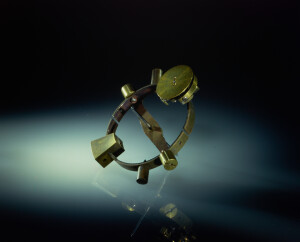 | SHORT DESCRIPTION: [Jonathan Betts, 2002] This balance, dating circa 1860, contains the auxiliary invented and patented by John Richard Lund (1815-1878). The balance itself is of standard form and with secondary compensation screws mounted on the rims about 10° round from the arms. The main compensation weights however consist of one conventional, wedge-shaped brass weight on one rim sector, the other rim sector mounted with a complex auxiliary mechanism acting at the same time as, but independently from the main balance. This mechanism is controlled by its own tiny bimetallic curb, protected under a brass cover, and this performs the M.T.E correction at the same time as the main balance rim sectors move during changes in temperature. A small weight within this mechanism is in its outermost position at middle temperatures, but when the temperature rises above, or falls below this middle range, the weight is caused (in both cases) to move towards the centre of the balance. This action diminishes the effect of the main compensation at low temperatures, but increases it in high temperatures. The action of the weight as the temperature changes from high to low is smooth and the compensation is thus of the continuous type. Theoretically however, this refined M.T.E correction only works correctly if a correcting weight is attached to both rim sectors, not just one. With only one weight the balance will inevitably become slightly out of poise as the correction takes place and a coloured plate forming the frontispiece of Barraud and Lund's 'Testimonials' of 1848 does indeed show a balance with one of these correcting weights on both rim sectors. In practice however, Barraud's only ever seem to have fitted one, as all the known chronometers fitted with this compensation have just one. The great advantage of the system was that it could be fitted to virtually any standard chronometer, when new or at a later date, by simply replacing the plain weights. J.R.Lund was apprenticed to John Pennington, son of Robert Pennington (one of the partners in Thomas Mudge Junior's enterprise, and after leaving Pennington and being in business briefly in Hatton Garden, he joined the great firm founded by Paul Philip Barraud in about 1838, the title then becoming Barraud and Lund. In 1842 Lund began correspondence with the Astronomer Royal, George Airy about the merits of this form of compensation. On 25 November 1843 Lund was granted patent No.9969 for this invention and the auxiliary was exhibited at the Great Exhibition in London in 1851. It was applied to a number of both 8 day and 2 day chronometers by Barraud & Lund and instruments with this special feature were given an additional identification on the dial, in the form of little gilt brass coats of arms, one the Royal arms (signifying the patent) and the other that of the Admiralty anchor, signifying that Barrauds were makers to the Admiralty. Lund simplified the mechanism somewhat in a later design, but the first model, of which the museum's is an example, is the type in all but one of the nine known chronometers fitted with this device. Diameter at rim: 26.5mms NOTES:[David Herbst October 1986] Chronometer collector, made the following notes: "During the years that chronometers were being made and repaired, balances of out-dated chronometers were just thrown in the corner as scrap. Since these were an important part in the development of the chronometer, Chamberlain collected them. He and Jean Louis Roerick spent hours at night in Chamberlain's kitchen working on a lathe, making the boxes for the balances. Roerick worked for Cartier's in the 1920's and later set up shop for himself. He set up the Swiss section in Ford's Greenfield Village." TIME-SPACE: LUND (1869-1901) ADDITIONAL INFORMATION: See Cedric Jagger, Paul Philip Barraud, AHS, 1968, & The Supplement… AHS, 1979; SEE MERCER, P. 204. TONY MERCER, CHRONOMETER MAKERS OF THE WORLD, COLCHESTER, 1991. | CL20739 | |||||||
| 10 | 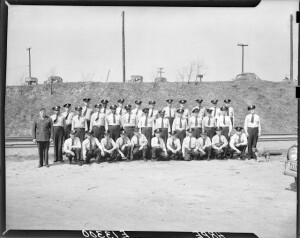 | 3/29/1945 | Port of Embarkation, Hampton Roads, Va. (U.S.)–Security measures. | Civilian Guards after inspection. Lt. Cyril G. Edwards, O-920678, Tamagua, Pa., Provost Marshal branch, Intelligence and Security Division, HRPE, Newport News, Va., is on the extreme left. This was the evening shift, 34 in number. Photo taken for Historical purposes. The 8 x 10 print reads: Group of Civilian Guards who were being inspected by Lt. Cyril G. Edwards, O-920678, Tamaqua, Pennsylvania, Provost Marshal Branch, Intelligence and Security Division, HRPE. Front row, left to right: Lt. Edwards; Ruben H. Holloman, Ahaskin, North Carolina; William J. Murray, Goldsboro, North Carolina, both of World War #1; James L. Perkins, Clifton, Virginia, World War #2; Joseph A. Jones, Blackstone, Virginia, World War #1; Arthur M. Hayes, Roxbury, Massachusetts, World War #1; William A. Hinton, Edgecomb County, North Carolina, World War #1; Richard E. Coley, Newport News, Virginia, World War #1; Earl Hendricks, Newport News, Virginia, World War #1; and Henry W. Nelson, Clifton Forge, Virginia, World War #1. Second row: Joseph Young, Hanover, Virginia, World War #1; Jesse J. Wilson, Lulmeburg County, Virginia, World War #1; Leroy Rice, Enka, North Carolina, World War #1; Edward Trent, Lynchburg, Virginia, World War #2; Tommie Howse, New Orleans, Louisiana, World War #1; William B. Mayes, Newport News, Virginia, World War #2; William DeBerry, Lewiston, North Carolina, World War #1; Provet L. Pate, Clemmon, North Carolina, World War #1; Walter Crisp, Jr., Hassell, North Carolina, World War #2; John P. Wiekel, Washington, D.C., World War #1, and Pryor Sharp, Elk Valley, Tennessee, World War #1. Third Row: Richard M. Martin, Mousie, Kentucky, World War #1; Louis L. Dyer, Washington, D.C., World War #1; Joseph B. Fraiser, Georgetown, South Carolina, World War #1; Walter C. Morris, Buckroe Beach, Virginia, World War #1; Charlie C. Pennington, Matoaka, West Virginia, World War #2; Joseph W. Slade, Franklin, Virginia, World War #1; James D. Casey, Spartansburg, South Carolina, World War #1, Charles H. Winstead, Roxbury, North Carolina, World War #2; Eugene J. Bevington, Grandville, Virginia, World War #1; Frank C. Thompson, Sythe County, Virginia, World War #1; and Albert H. Wiedebusch, Moundsville, West Virginia, World War #2. | Civilians in war–Virginia–Newport News. | Group portrait of civilian security guards with their officer. The front row is crouching down and also a dog has joined them. Other photos have noted that many of these men are veterans of World War I. | P0003/01-#E-13300 | |||
| 11 | No image URL. | Baltic (Screw schooner : 1903).; Titanic (Screw schooner : 1912). | The Captain's daughter : __Helen Melville Russell-Cooke : "Mel" 1898-1973. | LB108518 | ||||||
| 12 | No image URL. | Meteorology. | With this are bound his Experiments and observations to determine whether the quantity ofrain and dew is equal to the quantity of water carried off by the rivers and raised by evaporation... Manchester [1799]. And Experiments and observations on the heat and cold produced by themechanical condensation and rarefaction of air. 1800. | LB30618 | ||||||
| 13 | 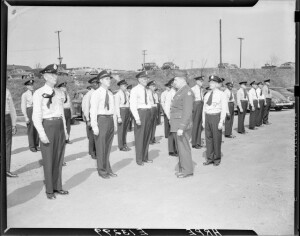 | 3/29/1945 | United States. Army–Inspection.; Port of Embarkation, Hampton Roads, Va. (U.S.)–Security measures. | Lt. Cyril G. Edwards, O-920678, Tamagua, Pa., Provost Marshal Branch, Intelligence and Security Division, HRPE, Newport News, Va., is shown inspecting a group of Civilian Guards at M.P. Control House, River Road. Photo taken for Historical purposes. | Civilians in war–Virginia–Newport News. | Shows a group of civilian security guards at attention for an inspection from an officer. Other photos have noted that many of these men are veterans of World War I. | P0003/01-#E-13299 | |||
| 14 | 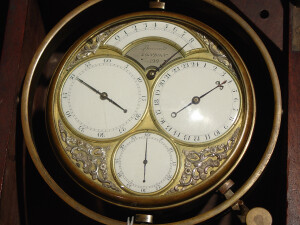 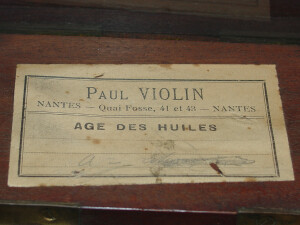 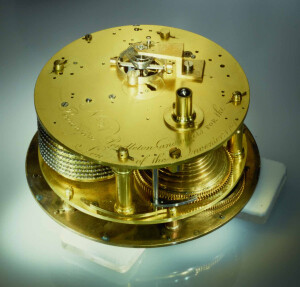 | SHORT DESCRIPTION: [Jonathan Betts, 2002] BOX/MOUNTING: Plain, square three-piece solid mahogany box, of French origin, ca 1860, 19.5cms high, 21cms wide and 20.5cms deep, with a plain mahogany top with butt hinges and a brass button catch opening to reveal a glazed panel for viewing the dial. The upper half of the box has plain hinges with a French type quadrant stop built into the right hand side of the box. Plain brass drop handles to sides and an inlaid brass, diamond escutcheon to the lock on the front. French-type lock with single loop. The heavy brass bowl containing movement has a narrow but deep, screwed brass bezel (9 full turns to remove) fitted with a convex glass over the dial. The base of the bowl has a central sink with a spring-loaded, swiveling shutter for access to the winding hole. The gimballing and layout of the interior of the box is of the standard type. The gimballing itself is quite heavily grained and lacquered. The beautifully made winding key dates from the original Mudge-type chronometer. It is fitted with a reverse ratchet and a sculpted and shaped ivory handle. Inside the back of the upper half is pasted a label which reads: "PAUL VIOLIN / NANTES - Quai Fosse, 41 et 43 - NANTES / AGES DES HUILES" and a manuscript name in pencil that has been obliterated. DIAL & HANDS: Gilt brass dial plate of 121 mms, with narrow, gilt brass rings retaining the three white-enamel dials for hours minutes and seconds and a segmental enamel up and down dial. Scrolling, leafy, cast silver spandrels (hollow behind) decorate the areas between the dials. Between the upper two dials, beneath the up and down dial, is a silvered brass, segmental plate engraved: "Barraud LONDON 399". The hour dial has 24 Arabic numerals, the minute dial Arabic five minute figures and the seconds dial Arabic five second figures. The up and down dial has Arabic figures from 0 to 8. The underside of the dial plate is stamped "26" and the counter enamel of the up and down enamel plate is marked: "26". The hands are in highly polished blued steel, all with counter poised tails except the up and down hand. The hour hand is of 'beetle' style, the minute and up and down hands a 'poker' and the seconds a fine pointer. MOVEMENT: Full plate, brass fusee movement with all frame parts fire-gilt and all brasswork very flat and highly polished. The upper side of the potence plate is engraved: "Pennington, Pendleton and others FOR the Son of the Inventor, 1797". The four finely turned pillars are mounted 'upside down', i.e. with the narrower end riveted to the pillar plate, the wider end pinned to the potence plate. The dial side of the pillar plate is stamped "26" and "100/50" and the underside of the potence plate is stamped: "26". The motive force consists of a double (tandem) mainspring and barrel assembly with two springs mounted one above the other, connected by a common barrel arbor running on small pivots in the frame. This system, fitted to Mudge's original eight day machine, all the eight day Mudge copies and some of the two day Mudge copies, was apparently intended as a means of ensuring as even a torque as possible to the train. However, the complexity and production cost of the assembly rather outweighs any small advantage the system may provide over a well-made standard arrangement of a single barrel and spring. The upper spring is contained in a barrel mounted, with ratchet wheel and click, on the potence plate and which is only revolved when setting up the springs. The lower spring is contained in a barrel, running on the barrel arbor, and which has a large, outer barrel upon which runs the fusee chain. This lower barrel may in fact have been adapted from a one-day machine as it has an additional chain hooking hole inside. Both mainsprings are blued steel and are (indistinctly) signed: "Bl Avril 1854". The reversed fusee has Harrison's maintaining power and conventional stop work. The lower end of the fusee arbor has the up and down pinion attached, which drives the up and down wheel under the dial. The train of wheels, all made to the highest standards, consists of four wheels plus the great wheel, the fourth wheel having a reverser wheel fixed to its arbor, meshing with an identical wheel having a plain arbor on the end of which is mounted the seconds hand. ESCAPEMENT, BALANCE & SPRING AND JEWELLING: Arnold-type spring detent escapement with the detent mounted between the plates on an Earnshaw-type brass limb with a depth-adjusting screw in the edge of the plate. The detent has a rectangular locking stone and a gold passing spring. The escape wheel is run between a potence and the potence plate. The simple brass and steel balance has circular brass compensation weights and a bright steel, conical balance spring with an upper terminal curve. The balance is run under a plain brass cock and the lower pivot of the balance staff still runs in the Mudge-designed anti-friction rollers. The fourth wheel and escapement parts are jeweled with endstones and the impulse and discharging pallets are both jeweled. ALTERATIONS/CONDITION: The chronometer would seem to have existed in three distinct states during the course of its life. The movement still has all the holes present in the plates where the original Mudge type escapement would have been and there is no doubt this was a completed Mudge type movement in 1797. It does not appear ever to have had the device fitted to Mudge's original 8 day machine and to the earlier Mudge copies, an eight day / two day lever to alter the duration of the timekeeper. It was almost certainly mounted in the usual octagonal inner box, on trunnions within the square outer box, but this cannot be proved. What seems certain is that around 1805 it was substantially altered by Paul Philip Barraud and renumbered No.399. During this rebuild the Barraud company replaced the whole escapement and balance assembly with the present Arnold-type escapement, probably fitting an Arnold-type compensation balance as well, and replaced the contrate fourth wheel with the present plain spur wheel. Then, perhaps in the mid-1850s and almost certainly in France by this time, the whole machine was updated again, this time having a new compensation balance and conical balance spring and being fitted with two new mainsprings. Then it was fitted into a whole new box with gimbals, made very much in the English style. The original, ivory, ratchet winding key was retained however, probably because the ratchet worked in the opposite direction from the usual keys of that kind and could not easily be replaced. The box is a little bumped and somewhat scratched in places but is generally sound. One piece of beading is missing from the observation glass, the fingerpiece is missing from the shutter on the bowl and the gimbals and bowl have parts where the lacquer is breaking down with areas of tarnishing and old, dried metal polish. The 4 turn screws for fixing into the original case have been filed and stoned off flush. There is one crack in the enamel of the up and down dial. The oil in the movement is generally quite gummy and old. PROVENANCE, ACQUISITION & NOTES: Nothing is known of this chronometer's early life, except that it must have been one of those instruments which Robert Pennington hastily tried to complete for the agreed sum of £150. The presence of the number 26 on the frame and dial parts suggests it was due to be completed with that number but was held back. A number of these chronometers have conflicting frame and plate numbers in this way and reflect the somewhat ad-hoc production system employed by the manufactory. Just a few years after completion it was in the hands of Paul Philip Barraud, who felt able to give the machine a whole new number from his own production series, No.399, dating the exercise to about 1805. That he gave his name and a number to it suggests it was his property, not just a repair job and it is tempting to suppose that he bought it as a part of ex-Mudge copy stock. By the mid-1850s the chronometer was evidently in France and was due for upgrading again, this time with a proper brass bowl and gimballed box to bring it properly up to date. At the same time the balance and spring were upgraded to the present type with a new balance cock made to suspend them. The conical balance spring was intended as a compromise between the helical and flat spiral springs and was considered by some makers (especially in France) to be superior to both, especially when fitted with a terminal curve. The chronometer appears to have stayed in France as it bears the 'Age of the Oil' trade label of Paul Violin, indicating it was serviced by him at the port of Nantes on the west coast, just up the river Loire from the naval base at St. Nazaire. The label probably dates from about 1912 when Violin succeeded to the business of A. Masselini who was working at that address from the beginning of the century. The chronometer was purchased by Frederick Hill during his field trip to France in 1937. It was acquired somewhere on the west coast, the price being FF2,750. This acquisition was described by Hill in a letter to Homer L. Ferguson on 31 March that year as one of their best purchases on the trip. Technical Information: (all dimensions in mms) Comment Potence Plate: 107.5 Pillar Plate: 107.4 Plate distance: 34.6 Mainspring & Barrel Upper: Inside barrel: 42 Thickness: .3-.15 tapered Height: 13.0 Lower: Inside barrel: 42 Thickness: .3-.15 tapered Height: 13.3 (springs signed as per data in catalogue entry) Wheel / Pinion Fusee/Great: 108 12-1/4 turns to reverse fusee Ratchet: 42 1 click Maintaining Power: 120 Great & Maintaining wheel both with 6 crossings Set up: 50 on upper barrel flange Centre/2nd: 128 / 12 6 tapered crossings Third: 120 / 12 6 tapered crossings (also tapered in thickness) Fourth: 100 / 12 6 tapered crossings Reversers: 50 4 curved crossings Escape: 15 / 10 4 curved crossings Balance Frequency: 18,000 vbs per hour (five beats in a second) Main driving wheel (to minutes wheel): 112 4 curved crossings Minutes wheel: 63 4 curved crossings Main driving pinion (to hour wheel): 10 Hour wheel: 135 4 curved crossings Up & Down driving pinion: 10 Up & Down interwheel: 48/10 4 curved crossings Up & Down wheel: 100 4 curved crossings Escape and Balance Escape wheel: 17.0 approx Impulse roller: 6.4 Balance: 25.5 Balance spring: Conical with 13 turns including upper terminal, anticlockwise down ADDITIONAL INFORMATION: SEE: Tony Mercer, Chronometer Makers of the World, Colchester, 1991.P. 248 | CL3227 | |||||||
| 15 | 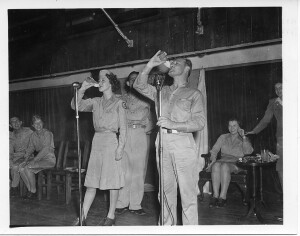 | 9/14/1944 | United States. Army.; United States. Army. Women's Army Corps.; United States. Army. Camp Patrick Henry (Va.). Service Club D. | J-9781 - Pvt. Tilda O. Laws, A-315691, 3rd WAC Co., CPH, Pennington Gap, Va., engages in a milk drinking contest against Cpl. Charles H. Lyons, 6716665, P.O.W. GD. Det., CPH, 124 West 82nd. St., N.Y.C. This program was put together thru the efforts of Cpl. Frank O. Wiziarde, 37247104-1329 Ser. Unit, CPH, his address - Kansas City, Mo. CPL. Wizarde appeared in Stage and Radio programs as "Taby Twilliger". Army Hour Prod. and Government shows in 4th, 7th, and 9th Service Commands. Photo taken at Service Club D, CPH. 9-14-44 Official Photograph, U. S. Army Signal Corps, HRPE, Newport News, Va. | Amusements–Virginia–Newport News.; Contests–Virginia–Newport News.; Soldiers–Recreation–Virginia–Newport News. | A soldier and a WAC stand on a stage in front of two microphones. Both are drinking glass bottles of milk. Another soldier stands behind them, and several WACs are seated in chairs along the back curtains on the stage. It is possible Cpl. Wiziarde is the man behind them. Later in life, he became known as "Whizzo the Clown". | P0003/01-#K-9781 | |||
| 16 | No image URL. | America–Discovery and exploration–English; Great Britain–Colonies–America; Great Britain–Territorial expansion; United States–History–Colonial period, ca. 1600-1775. | British–History. Ireland | "The essays in this volume are offered ... in tribute to D. B. Quinn to mark his retirement in 1976 from the Andrew Geddes and John Rankin Chair of Modern History at the University of Liverpool." Includes index. | LB8594 | |||||
| 17 | 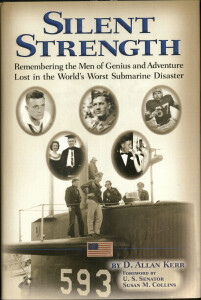 | Thresher (Submarine (nuclear powered) : SSN-593).; Portsmouth Naval Shipyard (U.S.)–History–20th century.; Portsmouth Naval Shipyard (U.S.). | United States–History–1953-1961. | Submarine disasters–Atlantic Ocean.; Shipyards–History–20th century. New Hampshire–Portsmouth; Submarines (Ships)–History.; Search and rescue operations–New Hampshire.; Submariners–United States–Biography. | "Compendium of articles from Seacoast online and the Portsmouth herald" P. [x]. | LB105464 | ||||
| 18 | 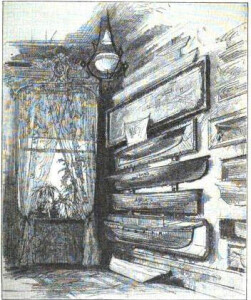 | SHORT DESCRIPTION: Builder’s half hull model, starboard side, made by George Steers of the pilot boat George Steers. The model is a basic representation of the vessel's molded lines, without constructional details. The model is not mounted on a backing board. The model is varnished and is inscribed in black-outlined letters “GEORGE STEERS.” The model has a slightly raked stem and an raked hour-glass shaped upper stern (no counter). It has moderate deadrise and little or no tumblehome. The model shows a boat with deep draft aft and a keel that slopes up to the forefoot. It has a long sharp entry and a long run aft. The model is constructed of 11 pine lifts. The bottom lift (1) is 1-5/8” and tapers to zero about 7-1/2” from the bow. Lifts 3 through 8 are flat and arranged in pairs, each consisting of 1/2” lift separated by a 1/8” lift. The sheer curve is cut into the 9th lift. It is 9/16” amidships, 2-1/16” at the stern, and 1-5/8” at the stem. Lift 10 is flat (1/8”) and curves with the sheer. Lift 11 curves with the sheer and tapers from 1-1/16” at the bow to 11/16” amidships to 3/16” at the stern. Lift 11 is also the top covering for the model, which is not hollowed out to deck level. The top and back of the model have twenty station lines running from bow to stern. Line eleven from the bow is a double line and may be the deadflat. They are spaced an 1-3/4” apart. There appear to be some scratched letters between several of the station lines but it’s unclear what they represent. The dimensions of the model are 34-1/4” (length overall); 4-11/16” (main breadth), 4-1/2” (half breadth), leaving a tumblehome of just 3/16”. Height overall is 6” (at the stern). The minimum half-breadth of the model is 3/32" along the edge of the stem and 1/8” at the stern. The lifts appear to be held together by six pegs running from top to bottom. The pegs are visible on the front surface of the model. There are a few variously sized holes whose purpose is not apparent on the top and back and front of the model. The model is in good condition. The varnish is stable. There is damage and some wood loss at the ends of lifts 2 through 5 at the bow. There is a separation between lifts 4 and 5 at the bow and stern. There is a small scratch through the ‘GE’ in the ship’s name. There is some wood loss in the second G. It appears as though another layer of varnish was applied to the model at some point in the recent past. NOTES: The collection of half models MR 5 through MR 24 are of vessels built by shipbuilders Henry (father), James Rich and George (sons), and Henry Steers (son of James Rich), builders of the famous yacht America. The models document vessels built between 1805 and approximately 1876. They encompass all types of vessels from a catboat up to large steam sloop built for the US Navy. In a February 13, 1963 letter Howard I. Chapelle, Curator of the Division of Transportation at the Smithsonian stated “The Steers Collection is important technically and it is something we envy the Mariners’ Museum’s possession.” NOTES: Text from “The Evolution of the American Yacht” in The Century Illustrated Monthly Magazine, Volume 24, page 352: Another modification of the Baltimore clipper was developed in our pilot-boats, which, little by little, assumed the type represented by the George Steers and Mary Taylor, famous little schooners designed by George Steers in 1845,--a type which continues to be followed, with little variation, in this service event now, after a lapse of forty years. They have a keel sloping up to the fore-foot, deep draft, great dead rise on a vertically sharp floor, and a sheer both at stem and stern which makes them buoyant and dry in a sea-way. Text from Pilots, The World of Pilotage Under Sail and Oar, Volume 1, page 82: [In 1851] Steers now came along with the 77ft George Steers, a shameless America derivative, but with a fashionable shorter bow overhang and an even more effective run. Steers was a favorite of Howard I. Chapelle and as one enjoys the pure perfection of her lines, one can see why....The George Steers stands as a fine example of that designer's final ideas of what a pilot schooner should be. Chapelle considered her run a slight improvement over that of America, while one can only agree that the balance of her ends is remarkable. This feature, coupled with a sensible depth of body would have conferred great seaworthiness and ease of motion, while the firm bilge of her midship section would ensure the now-usual Steer's feature of great power. Despite the altered profile, it is impossible to miss the similarity to America in the lines of this considerably smaller boat. She is said to have been one of the finest pilot craft ever built. The George Steers was driven ashore near Barnet Inlet in a notorious northeaster on February 12, 1865. All hands perished. VESSEL INFORMATION— VESSEL NAME: GEORGE STEERS VESSEL TYPE: Pilot boat, Pilot schooner DESIGNER: George Steers SHIPBUILDER: William H. Brown Shipyard BUILDER LOCATION: Foot of Twelfth Street, New York, New York SERVICE DATES: 1852-1865 DATE WRECKED: February 12, 1865 VESSEL DIMENSIONS: 60 tons; 77'4" (length overall), 71' (waterline length) x 18'10" x 9'6" VESSEL HISTORY: New Jersey Pilot Boat George Steers No. 6 • The Buffalo Commercial, Monday August 9, 1852: Launch.—A beautiful pilot-boat modeled by Geo. Steers, the builder of the yacht America, was launched by moonlight, at 12 o’clock on Thursday night, from the yard of Wm. H. Brown in New York. She was built for the Jersey pilots; has the same lines as the “America,” and is about half as large, or 87 tons. She will be the most beautiful as well as the fleetest pilot boat out of port. • The New York Times, August 20, 1852: The new pilot boat, built by Mr. George Steers for a company of Jersey Pilots, and named in honor of the builder, was got under way this morning for the first time, at the foot of Twelfth-street, East River. She left under command of Mr. Steers, who, in company with a few friends and acquaintances, will go as far as White Stone, to test the sailing qualities of the vessel, and for a pleasure excursion. • New York Herald, March 4, 1854 reported: the schooner George Steer had arrived (Honduras) with the president of the proposed railroad from Cabello to Tigre Island, who had gone on to the capital to consult with Mr. Borland. The George Steer, on her return, would take on board a Central American Minister to this country. • New York Daily Herald, March 10, 1854 reports: Interesting from Honduras (Jan. 22, 1854) Arrival of schooner George Steers—The most notable incident is the arrival of the schooner George Steers, from New York, in the unprecedented short time of a little more than thirteen days. She brings out Amory Edwards, Esq., President of the Honduras Railway Company, who left this morning for Comayagua, the capital, where he is gone with the local agent of the company to arrange for the commencement of practical operations on the line….The George Steers remains in port for the purpose of conveying to New Orleans the newly appointed Envoy to this State to the American government. • New York Daily Herald, April 8, 1854 reports: Omoa, Honduras, March 16, 1854: The George Steers is still here, in the employ of the Honduras Railway Company. • New York Daily Herald, May 24, 1854 reports: By the arrival yesterday in the lower bay, of the pilot boat George Steers, from Honduras via Omoa…The George Steers brings us as passengers General Joe Barrundia, Minister from Honduras, to represent the New Central American Mission at Washington, Don Laiuo Lasso, Secretary of Legation, the wife and son of the former, A. Edwards of New York [president of the Honduras Railroad Company], Herman Schmidt, of Brunswick, Germany, Mr. Charles Foller and Miss Foller of Omoa. The George Steers proceeds direct to New York. • New York Tribune, March 6, 1855 reports: Look out for slave catchers: A small incident occurred at the Black-slip, foot of Beekman St., in this City early this afternoon, which may serve as a caution to this community, which has been comparatively quiet on the subject of slave-catching since 26th of last May, when the case of Stephen Pembroke was so summarily disposed of. The George Steer, pilot-boat, laying is said slip, has two colored men employed in her service. As one of these men, who had been on shore, was about to step on board, he was hailed by two unstarred men, assuming to be officers in search of a burglar, intimating that he was the man, and demanding that he should go with them, at the same time touching him on the shoulder. He very wisely asked them to show their warrant. This was not done, but they insisted upon his going with them. At this time persons who had been watching the movement, stepped up and sustained the position taken by the man, that they were bound to show their warrant. While matters stood thus, two starred officers interfered, and said “he had better go with them to the Chief’s office; they are officers.” The result was that the man was attended by two faithful friends, who had some trouble before they were admitted. I have two prime witnesses to these transactions. This matter calls for explanation. Officers, starred or unstarred, have no right to arrest a man on charge of a serious crime without a warrant, or without knowing his name. This arrest was made in open day, when he was going about his honest business. (the article continues), written by J.W.C. Pennington. • Buffalo Daily Republic, October 2, 1858 reported: The steamer Delaware, hence for Philadelphia, came in contact, off the Woodlands, last evening, with the pilot boat George Steers. The latter lost bowsprit and had her bows stove in three or four feet, which caused her to leak badly. The Delaware towed her to quarantine and proceeded on her voyage. • New York Daily Herald, March 26, 1860 reported: the pilot boat George Steers towed the hulk of the sloop Spray (30 tons) from Barnegat Bay to port. It was assumed that the murder of Captain Leete and his brother had occurred and it was being investigated. • New York Daily Herald, May 10, 1860 reported: The arrival of the Japanese Embassy aboard the steam frigate Roanoke, arrived and anchored inside of Sandy Hook on May 9th.The ship was told to proceed to Hampton Roads and not enter the port (of New York). The NYDH’s special correspondent on board procured the services of the George Steers, and came up to town last evening with his despatches. • New York Times, February 23, 1865: Probable loss of the Pilot-boat George Steers and Crew. The pilot-boat George Steers has been missing since the gale of the 12th inst., and information has lately been received in this city which renders her total loss almost a matter of certainty. The last pilot was put out from her on the 11th inst., off Cape May. During the gale of the 12st inst., a pilot-boat was seen on the South Shoals near Barnegat. At daylight, the next morning, she appeared to be almost a wreck, all her masts having gone. On the 14th inst., a surf boat was enabled to get to her, but there was nothing of her left but a piece of the deck, some spars and rigging. A piece of her burgee was found in the rigging, with part of her name, which was “eorge.” All hands on board must have perished. Some dead bodies were found about twelve or fourteen miles south of where she lay, and as there was a heavy current setting in that direction at the time it is supposed they were the bodies of some of her crew. The George Steers was built in 1851 by the eminent ship-builder of that name. She belonged to the New Jersey Association; was valued at $15,000, and was supposed to be the fastest boat sailing from this port. ADDITIONAL INFORMATION: Chapelle, H.I. American Sailing Craft. 1936. pages 213-215 (VM331 C4); Russel, C.E. From Sandy Hook to 62 degrees". New York. 1929. page 387.; | CL14541 |
Created 2026 by Don Barker, CBMM volunteer, for the Chesapeake Shipbuilding Project. shipbuilding@sailingworkboats.es